

Best Whole House Air Purifiers for Pet Owners with Allergies in Spring 2026
🏆 Top Picks at a Glance
 #1
#1
Best Overall
Pet Air Purifier for Home Large Room 2500 sq ft, H13 HEPA Washable Double-Sided Filter,Air Cleaner for Pet Hair Dander Odor Allergies Pollutant Smoke Dust,PM2.5 Air Quality Monitor,Auto Mode,P358 Grey
$99.99
Check Price → #2
#2
Runner Up
DAYETTE Air Purifiers for Home Large Room Up to 2400 Ft² with Fragrance, Smart WiFi Alexa Control,Auto Mode, HEPA 14 Air Purifier with Washable Prefilter for Bedroom, Dorm Room, Pets, Office
$99.99
Check Price →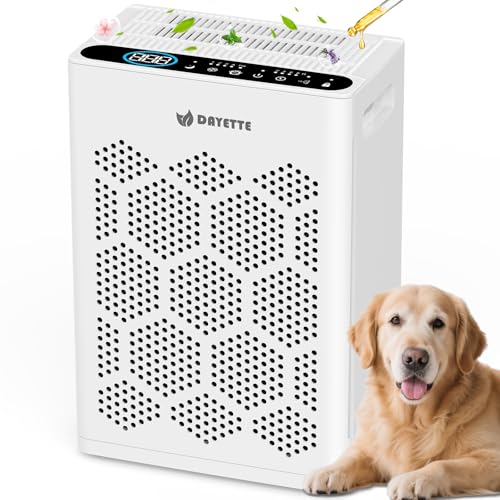 #3
#3
Best Value
DAYETTE Air Purifiers for Home Large Room Up to 2400 Ft² with HEPA 14 Filter, Pet Air Purifier with Washable Prefilter for Bedroom with Fragrance, Air Cleaner for Smoke Dust Pets Hair Odor, White
$89.99
Check Price →Our Top Picks
Affiliate disclosure: if you buy through these links, we may earn a commission at no extra cost to you.
Factors to Consider
Filtration efficiency, CADR, and particle sizes
⚡ Quick Answer
CADR and filtration efficiency are the practical measures of real cleaning performance. True HEPA captures 99.97% of 0.3 μm particles, and H13/H14 media used in quality purifiers often meet or exceed this for pet allergens. For pet allergies, target particles in the 0.3–5 μm range, where most dander-laden aerosols reside. Room size coverage matters: select a unit with CADR matched to your space (roughly 150–200 CFM for a 300–400 sq ft room; higher CADR for open layouts); this helps achieve meaningful air changes per hour. Replacement costs: typical HEPA cartridges run $30–60, with prefilters $10–20, and total annual costs scale with usage.
Table of Contents
Sizing for pet allergies and HVAC integration
Whole-house filtration relies on matching the device to your home's air volume and HVAC layout. For pet allergies, aim for 4–6 air changes per hour in the spaces you use most, which often means a higher CADR and possibly multiple returns or zone filtering. Look for manufacturers that list room-size coverage in square feet or ACH targets and verify compatibility with your furnace blower. Replacement costs for whole-house filters are typically higher, with larger cartridges costing roughly $50–100 each and annual maintenance depending on system use.
Filter lifecycle, media options, and ongoing costs
Beyond the main filter, consider prefilters and activated carbon for odors and VOCs common in homes with pets. Filtration frequency depends on pet presence and shedding—pets can shorten filter life to around 6–12 months in many setups. Room size coverage matters because an undersized filter will underperform in open plans or high-traffic areas; use the stated sq ft or ACH to guide replacement timing. Replacement costs vary by media: carbon filters add roughly $20–50 per unit, while HEPA cartridges commonly run $30–60, with total yearly costs rising with more frequent changes.
Noise, energy use, and practical spring usage
Noise level matters when you’ll run purifiers for long periods, particularly in bedrooms or study spaces; look for dB ratings and choose models with quiet modes at 20–40 dB. Energy efficiency matters for year-round operation, so compare wattage and check for ENERGY STAR certifications to estimate annual operating costs. The room-size policy still applies: a device sized for your space will perform better and avoid unnecessary energy use than a too-large unit running at low speed. Filter replacement costs add to the ongoing cost of ownership, typically $30–60 per HEPA cartridge and $10–20 per prefilter, depending on usage and accessibility.
Frequently Asked Questions
What does CADR mean and how do I translate it to room coverage?
CADR is a standardized metric published by AHAM that estimates how quickly a purifier can clean a given room size. A higher CADR means faster removal of smoke, dust, and pollen, which correlates with better control of airborne pet allergens. For practical sizing, aim for a CADR that matches your room size (roughly 150–200 CFM for a 300–400 sq ft space); larger open layouts typically require higher CADR or additional units to achieve 4–6 air changes per hour.
Are HEPA purifiers truly effective against pet dander?
Yes. True HEPA filters capture 99.97% of particles at 0.3 μm, which encompasses most pet dander carriers; pet allergens are often attached to particles within the 1–10 μm range, so HEPA filtration reduces airborne dander. Effectiveness depends on airflow, maintenance, and how well the unit is sized for the space.
How often should I replace filters in a pet-friendly home?
In homes with dogs or cats, many purifiers require filter changes every 6–12 months, depending on shedding and usage. Replacement costs typically run $30–60 for HEPA cartridges and $20–50 for carbon or combined media; if you have odor concerns, factor carbon filter replacements into the budget. Regular replacement helps maintain the expected CADR and filtration efficiency over time.
Can an air purifier remove odors from pets?
Purifiers with activated carbon or other odor-absorbing media can reduce pet odors and certain VOCs, but they don’t eliminate odors completely without adequate air turnover and cleaning of the environment. For best results, pair filtration with good ventilation and regular cleaning of pet areas.
Are ozone-generating purifiers safe for homes with pets?
Ozone generators can irritate lungs and mucous membranes in both people and animals; choose non-ozone-producing purifiers and look for CARB certification to ensure safety. For pet owners, HEPA filtration without ozone is the recommended path for consistent allergen control.
Do I need professional installation for a whole-house purifier?
Most whole-house units require installation into the HVAC ductwork, which is best done by a professional to ensure proper sizing and minimal pressure drop. After installation, ensure the system is sized for your home’s total CFM and that you replace filters as recommended; ongoing costs follow the same scale as individual units.
How should I place purifiers in an open floor plan?
Place purifiers in central locations with good air movement and away from walls to maximize cross-flow; in open layouts, multiple units or zone filtration can improve overall air quality. Always verify each unit’s stated room coverage to avoid oversizing or undersizing that could compromise performance.


