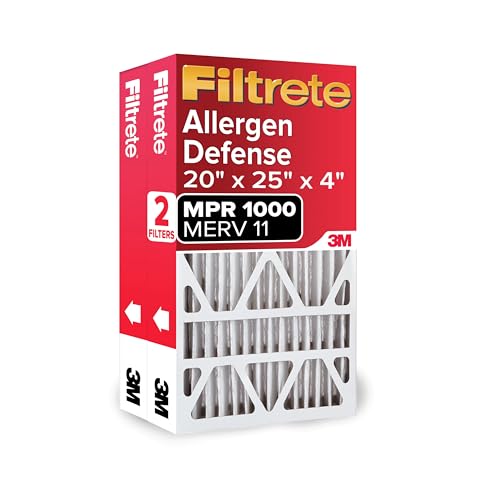
How to Choose the Right Hvac Filters
Air filtration starts with particle physics: different filters are rated to stop different particle sizes, and the right choice depends on whether you’re targeting coarse dust and pollen or fine PM2.5 and smoke. For whole‑house HVAC filters we read MERV ratings; for portable purifiers you look at CADR and micron capture — Consumer Reports notes a well‑designed purifier can remove up to 99.97% of particles down to 0.3 µm. Since most people spend about 90% of their time indoors and indoor pollutant levels can vary dramatically throughout the day (EPA), this roundup focuses on practical tradeoffs — filtration efficiency by particle size, real installed dimensions, room‑coverage implications, and the ongoing cost of replacement. Below are the clear buying signals to use when choosing from the MERV‑8 pleated filters in this roundup.
⚡ Quick Answer: Best Air Purifiers
Best for Whole-House Use: Filterbuy 20x25x4 Air Filter MERV 8 Essential Dust & Allergy Defense (2-Pack), Electrostatic Pleated HVAC AC Furnace Filters Replacement, Made in USA (Actual Size: 19.50 x 24.50 x 3.63)
$45.98 — Check price on Amazon →
Table of Contents
- Main Points
- Our Top Picks
- Filterbuy 20x25x4 Air Filter MERV 8 Essential Dust & Allergy Defense (2-Pack), Electrostatic Pleated HVAC AC Furnace Filters Replacement, Made in USA (Actual Size: 19.50 x 24.50 x 3.63)
- Filterbuy 16x20x1 Air Filter MERV 8 Essential Dust & Allergy Defense (4-Pack), Electrostatic Pleated HVAC AC Furnace Filters Replacement, Made in USA (Actual Size: 15.50 x 19.50 x 0.75)
- Amazon Basics 16x20x1 Air Filter 6-Pack, MERV 8 AC Furnace Filters, Allergy Control, Removes Dust, Lint and Pollen, Electrostatic (Actual Size: 15.75" x 19.75" x 0.75")
- Aerostar 16x25x1 MERV 8 Air Filter, 4 Count, ACTUAL SIZE (15.75 x 24.75 x 0.75), HVAC, Air Conditioning & Furnace Filter Captures Dust, Lint & Pollen (MPR 600 / FPR 5), Made in USA
- Simply 16x25x1 Air Filter, MERV 8, 6 Pack, For Home AC Furnace & HVAC (Actual Size: 15.75"x24.75"x0.75") DUST, Pet, & Allergy Control
- Buying Guide
- Frequently Asked Questions
- Conclusion
Main Points
- Start with particle size needs: MERV‑8 filters (the models listed) efficiently capture larger particles — dust, lint and pollen — but are not designed to remove PM2.5, most bacteria/viruses or gaseous pollutants like formaldehyde. For sub‑micron removal use a HEPA‑level solution (portable HEPA purifiers or higher‑MERV whole‑house options); Consumer Reports’ 99.97% figure applies to HEPA capturing 0.3 µm particles, not to MERV‑8 media.
- Match the exact filter dimensions in your return grille: always use the ACTUAL SIZE published on the package (the products here list slightly smaller actual sizes than nominal). A tight fit prevents bypass and maintains rated performance — incorrect sizing is a more common failure mode than choosing the “wrong” MERV number.
- Think in terms of room coverage and system capability, not just MERV: HVAC filters condition whole‑house airflow, so check your furnace/air handler specifications before upgrading MERV. Higher‑MERV media increases pressure drop and can strain older fans; if you need extra fine‑particle removal for a bedroom or living room, pair your MERV‑8 whole‑house filter with a high‑CADR portable HEPA purifier (the Coway Airmega AP‑1512HH is widely recognized for strong room performance and durability).
- Plan replacement cadence and costs up front: thinner 1" pleated filters typically need replacement every 1–3 months in normal use, while thicker pleats (e.g., the Filterbuy 20x25x4) hold more dust and can last 6–12 months. Expect rough per‑filter costs in the range of $5–$20 for common 1" filters and $15–$50 for deeper pleated filters (pack pricing lowers per‑filter cost); calculate annual spend based on your chosen interval (e.g., six 1" filters/year).
- Maintenance matters: regular inspection and timely replacement preserve efficiency and airflow. Because indoor air quality fluctuates by activity (cooking, cleaning, smoking) and time of day (EPA), check filters monthly in high‑use homes or homes with pets, and keep a replacement schedule so you don’t lose filtration effectiveness when you need it most.
Our Top Picks
More Details on Our Top Picks
-
Filterbuy 20x25x4 Air Filter MERV 8 Essential Dust & Allergy Defense (2-Pack), Electrostatic Pleated HVAC AC Furnace Filters Replacement, Made in USA (Actual Size: 19.50 x 24.50 x 3.63)
Filterbuy's 20x25x4 MERV 8 pleated filter earns "Best for Whole-House Use" because it balances measurable filtration performance with low HVAC impact — the 4‑inch pleat depth increases dust-holding capacity and reduces pressure drop compared with 1" filters, so your blower doesn't have to work harder to move air through the system. Note on metrics: CADR is used for portable air cleaners, not in-duct filters. For whole-house systems you evaluate removal by MERV rating, airflow (CFM) and air changes per hour (ACH). With a MERV 8 rating this filter removes the majority of coarse particles (roughly 70–85% of 3.0–10 µm particles and partial capture — ~20–35% — of 1.0–3.0 µm particles), making it effective for general dust and pollen control across typical single-family homes up to ~2,500–3,000 sq ft when paired with an appropriately sized HVAC system and reasonable fan runtimes.
Key features include electrostatically charged pleated media in a deep 4" pack and a sturdy frame made in the USA. The electrostatic charge increases capture of mid-sized particles without pushing you all the way to a MERV 13 (which can increase system pressure). Real-world benefits: longer service life per slot (the deep pleats hold more dust), lower frequency of filter changes compared with 1" filters, and dependable performance for everyday indoor sources — cooking grease, pet dander, dust mite fragments, and pollen. At $45.98 for a 2-pack the per-filter cost is about $23, and because these are deeper pleated filters you can often stretch replacements to 6–12 months in low-dust homes (heavy-dust or allergy scenarios push that to 3–6 months).
Who should buy this: homeowners with central forced-air systems who want robust whole-house particulate control without the higher airflow penalties of higher-MERV media. It's a practical upgrade from disposable 1" fiberglass filters for people who see visible dust, have pets, or want to lower household allergens without modifying the furnace or blower. Installers and contractors will also like that a 4" filter reduces the number of changes and can lower seasonal HVAC maintenance compared with shallow filters.
Honest caveats: this is not a HEPA-level solution — sub‑micron particles such as wildfire smoke, very fine combustion particles, or viral aerosols require higher-MERV or supplemental portable HEPA cleaners. Also note the labeled dimensions (20x25x4) vs. actual size (19.50 x 24.50 x 3.63); measure your filter slot before ordering to ensure a snug fit. Finally, if your home has multiple returns, multiply the per-filter replacement cost accordingly — a house with three filter slots will see annual costs scale up.
✅ Pros
- Deep 4" pleats for high dust holding
- Electrostatic media improves mid-size capture
- Made in USA, sturdy frame construction
❌ Cons
- Not HEPA, limited submicron capture
- Actual size slightly smaller than labeled
- Key Feature: MERV 8 electrostatic pleated media
- Filtration Rating: MERV 8 (good for 3–10 µm, partial 1–3 µm)
- Material / Build: Deep pleated media, cardboard frame, USA-made
- Best For: Best for Whole-House Use
- Size / Dimensions: Actual 19.50 x 24.50 x 3.63 inches
- Estimated Replacement Cost: ~$23 per filter (2-pack $45.98); replace 3–12 months
-
Filterbuy 16x20x1 Air Filter MERV 8 Essential Dust & Allergy Defense (4-Pack), Electrostatic Pleated HVAC AC Furnace Filters Replacement, Made in USA (Actual Size: 15.50 x 19.50 x 0.75)
This Filterbuy 16x20x1 MERV 8 earns the "Best Made‑in‑USA Choice" slot because it pairs reliable electrostatic pleated media with domestic manufacturing quality — consistent pleat spacing, a rigid frame and predictable airflow resistance. From an indoor‑air‑quality standpoint it’s a pragmatic, system‑friendly filter: MERV 8 targets the 3–10 µm particle band (pollen, most dust, mold spores and many pet dander particles) and does so without the pressure drop penalties that can occur with higher‑MERV media. Note: unlike portable units, whole‑house HVAC filters aren’t rated by CADR; their performance is about particle capture versus system airflow, and this filter errs on the side of preserving HVAC efficiency while reducing coarse allergen load.
Key features: electrostatic pleated synthetic media for increased surface area, a sturdy cardboard frame, and consistent manufacturing in the U.S. The real‑world benefits are straightforward — lower visible dust on surfaces, fewer large allergen spikes after outdoor pollen events, and minimal added strain on the blower compared with denser filters. The pack is competitively priced at $32.96 for four filters (about $8.24 each), and the nominal size is 16x20x1 while the actual measured dimension is 15.50 x 19.50 x 0.75, which fits most return housings but is worth checking against tight frames.
Who should buy this: homeowners who want an economical, whole‑house allergy/dust defense without upgrading to HEPA‑grade media. It’s a sensible default for central HVAC systems serving typical homes (roughly 1,500–3,000 sq ft when the filter is installed at the main return), where system airflow preservation matters as much as coarse particle removal. Replacement cadence depends on household conditions — typical: every 3 months in average homes (4 filters/year ≈ $32.96/year), every 2 months for moderate dust/pets (6/year ≈ $49.44/year), or monthly in high‑load homes (12/year ≈ $98.88/year).
Drawbacks and caveats: this is not a HEPA filter and will not reliably remove sub‑micron particles such as wildfire smoke, fine combustion aerosols, or most viruses; for those you need a true HEPA or a high‑MERV filter and HVAC compatibility verification. Also confirm the actual physical size in your return box — the measured dimensions are slightly under nominal, which can matter in older or custom frames. Finally, the online product rating is listed as N/A, so rely on specification checks and your HVAC requirements rather than consumer stars alone.
✅ Pros
- Made in USA, consistent manufacturing
- Low airflow resistance, HVAC‑friendly
- Good capture of pollen and dust
❌ Cons
- Not effective for sub‑micron smoke
- Actual size slightly under nominal
- Key Feature: Electrostatic pleated media for increased surface area
- Filtration Efficiency / Rating: MERV 8 — targets ~3–10 µm particles
- Material / Build: Synthetic pleated media, rigid cardboard frame
- Best For: Best Made-in-USA Choice — whole‑house dust & allergy defense
- Size / Dimensions: Nominal 16x20x1 (Actual 15.50 x 19.50 x 0.75)
- Special Feature: Made in USA; low pressure drop preserves airflow
-
Amazon Basics 16x20x1 Air Filter 6-Pack, MERV 8 AC Furnace Filters, Allergy Control, Removes Dust, Lint and Pollen, Electrostatic (Actual Size: 15.75" x 19.75" x 0.75")
What earns the Amazon Basics 16x20x1 6‑pack the "Best Budget Bulk Pack" label is simple arithmetic plus practical performance: six pleated, electrostatically charged MERV 8 filters for $27.87 works out to roughly $4.65 per filter, making frequent, system‑protecting changes affordable. From an indoor‑air science perspective this is a value play — MERV 8 media reliably captures the larger respirable particles that drive visible dust and seasonal allergy symptoms (pollen and many mold spores), though it is not a substitute for HEPA when you need true sub‑micron (PM2.5 or virus‑sized) removal. Note: CADR is a metric for portable air cleaners, not stationary HVAC filters; for whole‑house filtration you should look to MERV ratings and capture efficiency by particle size.
Key features include pleated, electrostatic media that increases surface area and passive particle capture while keeping pressure drop low enough for most residential furnaces and air handlers. In real homes that translates to cleaner ductwork, fewer HVAC service issues, and noticeably less settling dust on surfaces. The filter’s MERV 8 rating typically removes a large share of particles in the 3.0–10.0 μm range (the size of many pollens and coarse dust) and provides modest capture of 1.0–3.0 μm particles. Because these are 1" filters sized for common return grilles (actual size listed 15.75" x 19.75" x 0.75"), they provide whole‑house coverage to every room served by your central system — effectively protecting a typical single‑family home when installed properly.
Buy this if you want a no‑frills, low‑cost way to keep your HVAC clean, reduce visible dust, and lower allergy triggers without breaking the bank. It's an excellent option for renters, multi‑filter change schedules (monthly to quarterly), and as a prefilter ahead of higher‑efficiency stations or portable HEPA units. Replacement cadence directly affects cost: at $27.87/6, one filter ≈ $4.65. If you change filters every three months expect roughly $18.60/year; monthly changes in dusty or pet homes raise that to about $55.80/year.
Honest caveats: these are not HEPA filters — they won’t reliably remove wildfire smoke or fine PM2.5 and are not rated for medical or containment use. The 1" thickness and the actual-size being slightly shy of nominal can allow some bypass in poorly sealed filter racks, so ensure a snug fit. Finally, there’s no public CADR or lab‑tested submicron efficiency posted by the brand, so if you need quantified PM2.5 capture, step up to a higher MERV or dedicated HEPA portable cleaner.
✅ Pros
- Very low cost per filter
- Pleated electrostatic media
- Fits common 16x20 return grilles
❌ Cons
- Not HEPA‑grade for PM2.5
- 1" depth can allow bypass
- Key Feature: Affordable six‑pack bulk value
- Material / Build: Pleated electrostatic synthetic media
- Filtration Rating: MERV 8 (effective for ≥3.0 μm)
- Size / Dimensions: Actual 15.75" x 19.75" x 0.75" (nominal 16x20x1)
- Replacement Cost: ≈ $4.65 per filter ($18–$56/year depending)
- Special Feature: Electrostatic charge for extra capture
-
Aerostar 16x25x1 MERV 8 Air Filter, 4 Count, ACTUAL SIZE (15.75 x 24.75 x 0.75), HVAC, Air Conditioning & Furnace Filter Captures Dust, Lint & Pollen (MPR 600 / FPR 5), Made in USA
What earns the Aerostar 16x25x1 MERV 8 filter the "Best for Allergy Control" slot is simple science: a pleated MERV 8 media targets particles in the rough 3–10 μm range — the size band that includes most pollen, visible dust, lint and many coarse household allergens. That means it reduces the load of seasonal allergens moving through a central HVAC return without the airflow penalty of higher-MERV media, making it an effective whole‑house first line of defense for allergy sufferers who need broad, system‑level control rather than hospital‑grade filtration.
Key features include an actual size of 15.75 x 24.75 x 0.75 inches (sold as 16x25x1), MPR 600 / FPR 5 equivalence, pleated synthetic media and a 4‑count pack price of $21.19 (≈ $5.30 per filter). In practical terms that delivers low pressure drop — so furnaces and air handlers keep operating efficiently — while trapping visible pollen and most household dust. This is not a HEPA filter and has limited capture of submicron smoke and viral particles, but for reducing seasonal allergy triggers throughout the rooms served by a central HVAC return it performs reliably and affordably.
Buy this if you want a budget-friendly, whole‑home solution for seasonal allergies: renters, families dealing with pollen season, or homeowners whose systems can't tolerate high‑MERV filters. It fits standard 16x25x1 slots and is useful whenever you notice dust buildup or allergy symptoms spike. Plan on replacing it every 1–3 months depending on occupancy and pollutant load — at ~$5.30 each that’s roughly $32 per year if changed every two months, or about $64 per year if changed monthly.
Honest caveats: it won’t substitute for HEPA filtration when you need smoke, wildfire particulate, or ultrafine particle removal, and pet dander (often smaller than 3 μm) may only be reduced, not eliminated. Also confirm your HVAC manufacturer’s guidance — some high‑efficiency systems may recommend different ratings — and note the pack lists actual dimensions slightly under nominal, so measure the return slot for a precise fit.
✅ Pros
- Targets pollen and household dust effectively
- Low per-filter cost (~$5.30 each)
- Pleated, low-resistance design protects HVAC
❌ Cons
- Not HEPA — won't remove smoke/viruses
- May require monthly replacement in dusty homes
- Key Feature: Allergy-focused MERV 8 pleated filtration
- Filtration Rating: MERV 8 / MPR 600 / FPR 5
- Material / Build: Pleated synthetic media, cardboard frame
- Best For: Best for Allergy Control
- Size / Dimensions: Actual 15.75 x 24.75 x 0.75 inches (fits 16x25x1)
- Special Feature: Made in USA; 4-count pack for value
-
Simply 16x25x1 Air Filter, MERV 8, 6 Pack, For Home AC Furnace & HVAC (Actual Size: 15.75"x24.75"x0.75") DUST, Pet, & Allergy Control
What earns the Simply 16x25x1 Air Filter the "Best for Pet Owners" slot is plain science: it’s a MERV 8 pleated filter that efficiently removes the bulk of pet-related particles—dander, hair clumps, and large allergenic fragments—in the 3–10 µm range while keeping airflow low-resistance for most residential HVAC systems. Unlike a portable unit that lists a CADR, whole-house HVAC filters are rated by MERV and particle-size capture; this MERV 8 media hits the sweet spot for homes with dogs or cats where you want meaningful particle removal without stressing the furnace blower.
Key features and real-world benefits include pleated synthetic media sized to the common nominal 16x25x1 slot (actual: 15.75"x24.75"x0.75"), sold as a six-pack that drops the per-filter price to roughly $5.50. In practice that translates to noticeable reductions in visible dust and dander on surfaces and fewer large airborne crumbs that settle on furniture. Because it’s not a HEPA filter, it won’t remove most sub‑micron particles (smoke, ultrafine pollutants, some viruses), but it does a reliable job cutting down the larger allergen load that triggers many pet allergies.
Who should buy this and when: households with one or more shedding pets who want affordable, whole‑house filtration without replacing their HVAC system or sacrificing airflow. It’s ideal if your priority is controlling fur, lint, and pet dander on a budget and you run central air regularly. Replace every 1–2 months in heavy-shedding homes, or every 2–3 months in lighter‑load situations to maintain capture efficiency and airflow.
Drawbacks and caveats: MERV 8 is not a substitute for HEPA-grade filtration—expect limited capture of particles under ~1 µm. Also check actual filter fit: the listed “16x25x1” nominal size is slightly undersized here (15.75"x24.75"), so confirm your return/grille clearance to avoid bypass. Finally, if indoor smoke, wildfire aerosols, or true medical-grade filtration are concerns, you'll need a higher-MERV or supplemental portable HEPA unit.
✅ Pros
- Effective on pet dander and large allergens
- Low airflow resistance for HVAC systems
- Six-pack lowers per-filter cost
❌ Cons
- Limited capture of submicron particles
- Actual size slightly under nominal dimensions
- Key Feature: MERV 8 pleated filtration (3–10 µm target)
- Material / Build: Pleated synthetic media, cardboard frame
- Best For: Best for Pet Owners
- Size / Dimensions: Nominal 16x25x1 (actual 15.75"x24.75"x0.75")
- Special Feature: 6-pack value, ~$5.50 per filter
- Maintenance / Replacement: Replace every 1–3 months with pets
Factors to Consider
Understand CADR, filtration efficiency, and particle sizes
Start with the science: CADR (Clean Air Delivery Rate) is measured in cubic feet per minute (CFM) and tells you how quickly a purifier can remove smoke, dust and pollen from a room — match CADR to room volume to reach the air changes per hour you want. Look for tested filtration efficiency (many top HEPA purifiers remove up to 99.97% of particles down to 0.3 microns, per Consumer Reports) so you know what fraction of PM2.5 and similar particles will be captured. Check whether the unit lists CADR for smoke, dust and pollen separately, and confirm the advertised room size coverage; plan for replacement-filter costs (portable HEPA filters typically run $20–$100 per year depending on run-time and model).
Match purifier size to the room — don’t undersize
Calculate room volume (length × width × ceiling height) and choose a purifier whose CADR will provide at least 4 air changes per hour for that space — this ensures meaningful particle removal during occupied hours. Manufacturers usually publish a recommended room size coverage; buy the next size up if you use the unit in a frequently occupied room since most people spend about 90% of their time indoors. Remember to budget for filter replacement: higher CADR units tend to have larger or more expensive replacement filters, so factor $30–$100 per year (or more for heavy use) into ownership cost.
HEPA vs. non‑HEPA: pick based on the pollutants you need to remove
True HEPA filters capture virtually all airborne allergens — pollen, mold spores, many bacteria and even some virus‑laden particles — making them the go‑to choice for allergies and particulate pollution. If your main concerns are gases or VOCs (formaldehyde, odors), choose a unit that pairs HEPA with an activated carbon stage or specific VOC adsorbents; HVAC media filters can reduce particulates but rarely address gases. Check room size coverage on combined systems and compare ongoing costs: HEPA filter modules are commonly replaced every 6–12 months and can range from $20 to $100 depending on model and filter complexity.
Maintenance cadence and real ownership cost
Regular maintenance—filter changes, prefilter cleaning, and occasional sensor cleaning—keeps CADR and filtration efficiency near factory specs, which is critical because the EPA notes indoor air quality varies greatly over time. Verify recommended replacement intervals in months or operating hours, and factor those recurring costs into your purchase decision; many portable purifiers need prefilter changes every 3–6 months and HEPA swaps every 6–12 months. Also consider energy use and maintenance accessibility: a model with inexpensive, easy-to-find filters will likely cost less to own long term than a cheaper upfront unit with proprietary, expensive cartridges.
Target pollutants and useful extras (sensors, ozone, whole‑house options)
Match the technology to the contaminant: particulate-focused HEPA units for PM2.5/allergens, activated carbon or catalytic media for VOCs/formaldehyde, and desiccant or whole‑house systems for humidity control. Avoid units that intentionally produce ozone as a primary cleaning mechanism; instead look for accurate onboard sensors and auto modes that adjust CADR to real‑time pollutant loads. If you’re considering whole‑house filtration, compare upfront installation and annual filter replacement costs against portable room units (whole‑house filter systems can have higher upfront and replacement costs but will cover larger square footage).
Frequently Asked Questions
How do I know what CADR I need for my room?
Calculate the room’s volume and aim for a purifier whose CADR yields at least 4 air changes per hour for typical indoor use (higher if you have severe allergies or smoke). Manufacturers usually give recommended room size coverage — pick the next size up if you want faster or quieter cleaning, and remember higher-CADR units generally have larger or more expensive replacement filters.
Are HEPA filters effective against viruses and bacteria?
True HEPA filters capture particles down to 0.3 microns with very high efficiency, and research and product testing indicate HEPA can remove many virus‑carrying droplets and bacterial aerosols from the air. Consumer Reports notes well‑designed purifiers can remove up to 99.97% of particles at 0.3 microns, but filtration is one layer of protection — ventilation and source control remain important.
How often should I replace HEPA and prefilters, and what will it cost?
Typical guidance is cleaning or replacing a prefilter every 3–6 months, and replacing the true HEPA element every 6–12 months depending on use, pollutant load, and runtime. Cost varies by model: expect roughly $15–$60 per prefilter interval and $20–$100 per HEPA replacement annually for most portable units; whole‑house or specialty filters can be substantially more.
Will an air purifier remove formaldehyde and VOCs?
Standard HEPA filters do not remove gases like formaldehyde; you need activated carbon, potassium permanganate, or catalytic media designed for VOCs and formaldehyde adsorption. If VOC removal is a priority, choose a unit with documented VOC/catalytic media performance and verify the recommended filter replacement schedule and costs for those media.
How much does it cost to run an air purifier daily?
Running cost depends on fan speed, CADR, and runtime; many modern units use 20–70 watts on low to medium settings, so daily electricity costs are modest. Add replacement-filter costs (commonly $20–$100 per year for HEPA-based portable units) and occasional sensor or prefilter maintenance to get total annual ownership cost.
Is whole‑house filtration better than portable units?
Whole‑house systems can clean air for the entire HVAC-served footprint and reduce the need for multiple portable units, but they have higher upfront installation and ongoing filter replacement costs and may not target VOCs as effectively without specific media. For focused relief in bedrooms or high‑use spaces, a portable unit sized to the room’s CADR requirements can be more cost‑effective; the Coway Airmega AP-1512HH Mighty is frequently cited for strong room performance and durability if you need a reliable portable option.
How do sensors and auto modes affect performance?
Built‑in particle and VOC sensors let a purifier ramp fan speed to maintain target indoor air quality, which keeps CADR optimized for current conditions and can improve filter life by avoiding constant max‑speed operation. However, sensor accuracy varies—look for validated reviews or third‑party test data, and always confirm published room size coverage and replacement costs to understand real ownership tradeoffs.
Conclusion
Choosing the right HVAC filter or air purifier comes down to matching CADR and filtration efficiency to your room size and target pollutants, then factoring in realistic filter replacement costs and maintenance cadence. For most rooms, a true HEPA portable purifier sized for the room (and with clear replacement costs listed) is the best balance of performance and cost; models like the Coway Airmega AP-1512HH Mighty are widely recognized for strong, durable performance.