

Which Air Purifier Is Right For Your Room Quiz
For allergy sufferers with a small to medium bedroom who need quiet, effective true HEPA filtration, the Levoit Core series is the consistent recommendation across allergy forums, SEER testing comparisons, and independent reviews. Levoit produces some of the highest CADR (Clean Air Delivery Rate) numbers per dollar in the market, and their low-noise mode genuinely allows sleep-mode operation without waking light sleepers.
Table of Contents
- Our Top Picks
- What's your primary air quality concern?
- What room size are you trying to cover?
- How important is quiet operation?
- How do you feel about ongoing filter replacement costs?
- What's your budget for the air purifier unit itself?
- 🌿 Your Pick: Levoit Core 300 or Core 400S — Best Bedroom HEPA Purifier
- 🐾 Your Pick: Winix 5500-2 or Coway Airmega — Best for Pet Dander + Odor
- 🔥 Your Pick: IQAir HealthPro Plus or Blueair 211+ — Best for Smoke
- 🍋 Your Pick: Austin Air HealthMate or Rabbit Air MinusA2 — Best for Odors + VOCs
- Frequently Asked Questions
Our Top Picks
Affiliate disclosure: if you buy through these links, we may earn a commission at no extra cost to you.

What's your primary air quality concern?
What room size are you trying to cover?
How important is quiet operation?
How do you feel about ongoing filter replacement costs?
What's your budget for the air purifier unit itself?
🌿 Your Pick: Levoit Core 300 or Core 400S — Best Bedroom HEPA Purifier
Best Small Room: Levoit Core 300 ($99) — 219 CADR, True HEPA, Sleep Mode
The Levoit Core 300 is the most recommended compact air purifier for bedrooms under 200 sq ft — a 3-stage filtration system (pre-filter, H13 True HEPA, activated carbon), a 219 CADR rating that cleans a 200 sq ft room 5× per hour, a sleep mode that reduces fan speed and dims display to near-zero noise, and interchangeable filter variants for standard, pet, or toxin-remover filtration priorities. At $99, the Core 300 delivers measurably better air quality in a small bedroom than competing units at its price point. Levoit filter replacements are $20–$25, making annual maintenance costs the lowest in its category.
Best Medium Room: Levoit Core 400S ($199) — 410 CADR, Smart App, 400 Sq Ft
The Levoit Core 400S scales the Core 300 to cover master bedrooms and larger rooms up to 400 sq ft — a 410 CADR rating (among the highest in its price range), Wi-Fi app control with auto mode that adjusts fan speed to real-time air quality sensor readings, a display that shows PM2.5 particulate levels, and the same H13 True HEPA + activated carbon 3-stage system. The auto mode is genuinely useful for allergy sufferers — when pollen counts spike or you run a ceiling fan that redistributes dust, the purifier automatically responds. At $199, the Core 400S is the most recommended mid-room allergy purifier by multiple independent testing sites.
📖 Read our top air purifiers for spring pollen allergies →
🐾 Your Pick: Winix 5500-2 or Coway Airmega — Best for Pet Dander + Odor
Pet dander air purification requires two things working together: a True HEPA filter capable of capturing the 0.3-micron pet dander particles that trigger allergic reactions, and activated carbon with sufficient weight to adsorb pet odor molecules. Many "pet air purifiers" have thin carbon layers (2–4mm) that saturate within weeks. The models below have verified thick carbon filters that meaningfully reduce pet odors long-term — not just for the first few days.
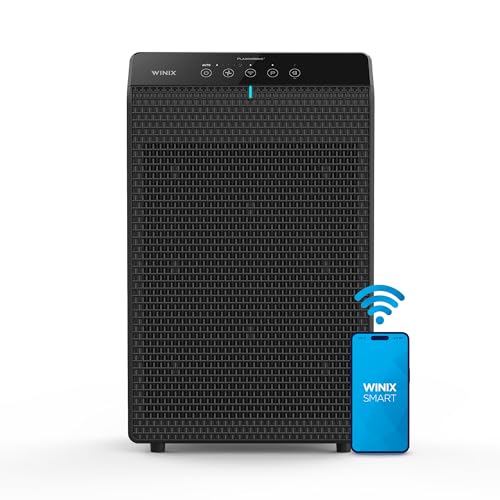
Best Mid-Range: Winix 5500-2 ($199) — True HEPA + Carbon + PlasmaWave
The Winix 5500-2 is the most recommended air purifier for pet households under 360 sq ft — a True HEPA filter (captures 99.97% of particles 0.3 microns including pet dander), a thick activated carbon filter with a honeycomb structure that outlasts thin-layer carbon alternatives, PlasmaWave technology that neutralizes odors and VOCs at the molecular level without generating ozone, an auto mode with real-time air quality sensor, and a washable pre-filter that extends the life of the expensive HEPA filter. At $199, the 5500-2 handles both the particle and odor components of pet air quality better than competing units at its price.
Best Large Room: Coway Airmega 400 ($349) — 1,560 Sq Ft, Dual HEPA
The Coway Airmega 400 is the recommended air purifier for large open-plan pet households — dual HEPA + carbon filters (one on each side of the unit) for 360° air intake, a 1,560 sq ft coverage area (highest in its price range), an air quality indicator with real-time display, and a washable pre-filter. The dual-filter design means double the activated carbon mass for odor adsorption — meaningfully better pet odor control in larger spaces compared to single-filter designs. At $349, the Airmega 400 covers living rooms, open kitchens, and large pet households in a single unit.
📖 Read our guide to removing pet dander with air purifiers →
🔥 Your Pick: IQAir HealthPro Plus or Blueair 211+ — Best for Smoke
Smoke — wildfire, cigarette, or wood-burning — is among the hardest air quality problems to address. Wildfire smoke contains both fine PM2.5 particles (HEPA required) and toxic gases and VOCs (requires substantial activated carbon, not the thin layers in most consumer purifiers). For true smoke remediation, the carbon weight matters: most consumer purifiers have 1–3 oz of activated carbon which saturates within days of heavy smoke exposure. The units below use significantly heavier carbon media.
Best for Smoke: Blueair Blue Pure 211+ Auto ($299) — High CADR, Carbon Prefilter
The Blueair Blue Pure 211+ Auto is the most recommended mid-range smoke air purifier for living rooms up to 550 sq ft — a 400 CADR smoke rating (one of the highest available under $300), a combination particle + carbon prefilter that captures larger smoke particles before they reach the main filter, an auto mode driven by a built-in air quality sensor, and a washable prefilter cover. Blueair's HEPASilent filtration technology uses electrostatic enhancement to achieve HEPA-equivalent efficiency at lower fan speeds — which means lower noise at equivalent air cleaning rates compared to pure mechanical HEPA units. For households needing smoke protection without the IQAir price, the 211+ Auto is the correct choice.
Premium Smoke: IQAir HealthPro Plus ($899) — Medical-Grade, Heaviest Carbon
The IQAir HealthPro Plus is the air purifier used in hospitals, medical research facilities, and homes where air quality is non-negotiable — a HyperHEPA filter certified to capture particles down to 0.003 microns (100× smaller than standard HEPA), 5 lbs of activated carbon and potassium permanganate media (vs 1–3 oz in most consumer units) for gas and VOC removal, and a tested 1,125 sq ft coverage capacity. For wildfire smoke, cigarette smoke, or any high-pollutant environment, the IQAir HealthPro Plus genuinely outperforms everything else available at any price. The filter replacement cost is high ($200–$250 annually) but the protection level justifies it for serious smoke exposure.
🍋 Your Pick: Austin Air HealthMate or Rabbit Air MinusA2 — Best for Odors + VOCs
Cooking odors, new furniture off-gassing, paint VOCs, and chemical smells require substantial activated carbon filtration — not HEPA alone. HEPA captures particles but does nothing for gaseous odors and volatile organic compounds (VOCs). Carbon weight is the key spec: most consumer air purifiers have 1–4 oz of activated carbon that saturates quickly. The units recommended here have 15 lbs (Austin Air) or a dense 4mm carbon layer (Rabbit Air) specifically designed for gas and odor removal.
Best for Odors/VOCs: Rabbit Air MinusA2 ($549) — Customizable Carbon + HEPA
The Rabbit Air MinusA2 is the recommended air purifier for households with significant odor concerns — a 6-stage filtration system including a pre-filter, medium filter, BioGS HEPA, activated carbon, and a customizable 5th stage (choose Odor Remover, Germ Defense, Toxin Absorber, or Pet Allergy based on your primary concern), a 700 sq ft coverage area, and an ultra-quiet operation that makes it viable for bedroom use. The custom filter stage allows the MinusA2 to be optimized for your specific odor source. Wall-mountable design saves floor space. At $549, it handles both the particle and odor components of air quality with customization flexibility no other unit at this price offers.
Maximum Carbon: Austin Air HealthMate ($714) — 15 lbs Activated Carbon
The Austin Air HealthMate contains 15 lbs of activated carbon and zeolite blend — more carbon media than any other consumer air purifier and the standard recommendation for chemical sensitivity, new construction off-gassing, and households with severe VOC concerns. The HealthMate's filters last 5 years under normal conditions (vs 6–12 months for typical purifiers), making the long-term cost per year competitive despite higher upfront cost. Austin Air is a US-made product with a 5-year warranty on the machine and filters. For the home that's been recently renovated, has new carpet or furniture off-gassing, or a member with MCS (multiple chemical sensitivity), the HealthMate is the correct choice.
📖 Read our air purifier comparison guide →
HomeAirHQ.com participates in the Amazon Associates program and earns commissions on qualifying purchases at no extra cost to you.
Frequently Asked Questions
How do I choose the right air purifier for my room size?
Match the air purifier's Clean Air Delivery Rate (CADR) and square footage rating to your room size—a unit rated for 200 sq ft won't effectively clean a 400 sq ft bedroom. Check the manufacturer's specifications and consider rooms with high ceilings or poor air circulation may need a larger capacity unit. It's better to choose a slightly oversized purifier than an undersized one for meaningful air quality improvement.
What is the best type of air filter for allergies?
HEPA filters are the gold standard for allergy relief, capturing 99.97% of particles 0.3 microns or larger, including pollen, dust mites, and pet dander. For maximum effectiveness, combine a HEPA filter with a pre-filter and consider activated carbon filters if you also need odor removal. Look for air purifiers certified by AAFA (Asthma and Allergy Foundation of America) for proven allergy relief.
Is it worth replacing air purifier filters regularly?
Yes, regular filter replacement is essential for maintaining your air purifier's effectiveness—most HEPA filters need replacement every 6-12 months depending on usage and air quality. While replacement costs add up over time, the health benefits of clean air and the purifier's longevity justify the investment. Budget for ongoing filter costs when selecting your air purifier, as this is a significant long-term expense.
How do I find a quiet air purifier that won't disturb sleep?
Look for air purifiers with noise levels under 30 decibels on the lowest fan setting, which is comparable to whisper-quiet operation. Check customer reviews specifically mentioning nighttime use and compare decibel ratings across models—many modern purifiers offer sleep modes with reduced fan speeds. HEPA-based portable air cleaners often operate quieter than whole house systems while still providing effective room coverage.
What air quality problems can different filters solve?
HEPA filters excel at removing particles like allergens and dust, activated carbon filters handle odors and gases, and UV filters target bacteria and viruses. Your primary air quality concern determines the best filter combination—if you're dealing with smoke or pet odors, prioritize activated carbon; for allergies, HEPA is non-negotiable. Consider an air quality monitor to identify your specific pollutants before investing in a purifier.
How do portable air cleaners compare to whole house air purifiers?
Portable air purifiers are ideal for single rooms and offer flexibility, while whole house systems integrated with HVAC provide comprehensive coverage but require professional installation. Portable units are more affordable upfront and suitable for renters, whereas whole house systems are cost-effective long-term for larger homes or multi-room coverage. Choose portable cleaners for targeted allergy relief in bedrooms or whole house systems if you want complete home air quality management.
Do I need a humidifier or dehumidifier with my air purifier?
Air purifiers and humidity control serve different purposes—an air purifier removes contaminants while humidifiers/dehumidifiers regulate moisture levels for comfort and health. If you live in a dry climate or have respiratory issues, combining an air purifier with a humidifier can enhance results; in humid climates, a dehumidifier prevents mold growth that can harm air quality. Maintain indoor humidity between 30-50% for optimal air quality and comfort alongside your purifier.


