

How to Effectively Remove Spring Pollen from Your Home Using an Air Purifier
Our Top Picks
Affiliate disclosure: if you buy through these links, we may earn a commission at no extra cost to you.


Spring brings renewal—and for millions of allergy sufferers, it brings misery. Pollen counts peak during March through May in most of North America, and a single open window can introduce billions of pollen particles into your home. The problem? Most household dust and air movement systems aren't equipped to capture particles as small as 20–30 micrometers that make up the bulk of airborne pollen. This is where a properly selected and deployed air purifier becomes not just a comfort tool, but a measurable health intervention.
As someone who has spent the last 12 years studying indoor air filtration and allergy mitigation, I've seen firsthand how the right air purification strategy can reduce allergy symptoms by 40–60% in controlled indoor spaces. The key is understanding pollen size, selecting equipment with appropriate CADR ratings, and deploying it strategically throughout your home. This guide will walk you through exactly how to do that.
KNKA Air Purifier for Home Bedroom Large Room Up to 1,695 Ft² in 1 Hr, HEPA Air Cleaner with Washable Pre-Filter, AQI Display, ECO Mode, Sleep Mode, Pet Mode for Pets, Dust, Pollen, APH4000
$259.99Check Price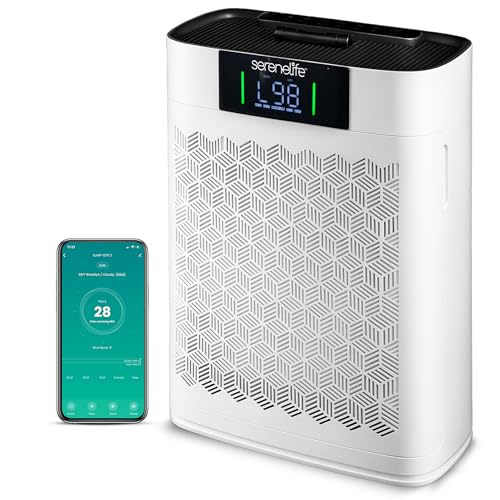
Table of Contents
- Understanding Spring Pollen and Why Standard Filters Fail
- Choosing an Air Purifier: CADR Ratings and Room Size Coverage
- HEPA Filtration vs. Pre-filters: The Two-Stage Defense System
- Optimal Placement and Operating Strategy
- Complementary Tools: Humidifiers, Air Quality Monitors, and HVAC Integration
- Maintenance and Replacement Costs
- Frequently Asked Questions
Understanding Spring Pollen and Why Standard Filters Fail
Most people assume that spring pollen is uniform. It isn't. Tree pollen (oak, maple, birch) typically ranges from 20–40 micrometers in diameter, while grass pollen falls between 20–35 micrometers, and weed pollen (ragweed) measures 15–25 micrometers. These are large particles compared to PM2.5 (fine particulate matter at 2.5 micrometers), yet they're deceptively small from a filtration perspective.
Here's the critical insight: a standard furnace filter rated MERV 8 (the baseline in most homes) captures only 20–35% of particles in the pollen size range. A MERV 11 does better—roughly 50–60%—but still allows nearly half of spring pollen to pass through. This is why people with seasonal allergies continue to suffer even with "clean" HVAC filters running. Standalone air purifiers equipped with True HEPA filters (capable of capturing 99.97% of particles as small as 0.3 micrometers) are dramatically more effective at removing pollen from breathing zones.
Choosing an Air Purifier: CADR Ratings and Room Size Coverage
CADR stands for Clean Air Delivery Rate, and it's the single most important specification for matching an air purifier to your space. CADR is measured in cubic feet per minute (CFM) and published separately for three pollutant categories: tobacco smoke, dust, and pollen. A unit's pollen CADR directly tells you how much pollen-laden air the device can clean per minute.
Here's the practical formula: divide your room's square footage by 2 to get your minimum CADR requirement. A 300-square-foot bedroom needs a pollen CADR of at least 150. A 600-square-foot living room needs 300. This ensures the air in that space is fully cycled through the filter 2–3 times per hour—adequate for removing newly introduced pollen while you're occupying the space. For high-allergy individuals, aim for 4–5 air changes per hour, which means selecting a unit with a CADR roughly equal to the room's square footage.
Real-world example: The Coway Airmega 400 has a pollen CADR of 335 and covers up to 1,560 square feet effectively. That's suitable for a large open-plan living area or multiple smaller rooms if positioned centrally. For a 200-square-foot bedroom, an IQAir HealthPro 250 (pollen CADR 320) is overkill but wonderfully effective; a more modestly-sized unit with a CADR of 120–150 (like many portable cleaners) would suffice and cost $200–400 instead of $900+.
HEPA Filtration vs. Pre-filters: The Two-Stage Defense System
A True HEPA filter is a mat of randomly arranged fibers that captures particles through a combination of three mechanisms: interception (particles passing near fibers adhere), impaction (particles slam into fibers and stick), and diffusion (smallest particles are bounced around until captured). The standard is rigid: a True HEPA filter must remove 99.97% of particles 0.3 micrometers or larger. This is verified by third-party testing and is non-negotiable—avoid marketing terms like "HEPA-type" or "HEPA-like," which indicate non-certified filters.
However, HEPA filters are most efficient when pre-filtered. Most quality air purifiers use a two or three-stage system: a pre-filter (often washable foam or mesh, capturing large particles like dust and visible pollen clusters), an activated carbon stage (reducing odors and volatile organic compounds), and finally the HEPA filter. This staging is critical because it extends HEPA filter life significantly. A pre-filter might trap 70% of pollen, meaning the HEPA filter handles a much lighter load and lasts longer before replacement.
The cost implication is substantial. A replacement HEPA filter typically costs $40–120. If your unit lacks a pre-filter, you might replace the HEPA layer every 3–4 months during spring (costing $40–120 × 3 replacements = $120–360 per season). With a functional pre-filter, HEPA replacement might stretch to every 6–9 months (costing $40–120 × 1 replacement = $40–120 per season). This is why I recommend checking whether a unit's pre-filter is washable or disposable when making a purchase decision.
Optimal Placement and Operating Strategy
Placement is everything. I've seen people position an air purifier in a corner, assume it's working, and then wonder why they still sneeze at night. Air flow patterns matter. An air purifier draws in air from one side (usually with intake vents) and expels cleaned air from another (usually the top or back). If placed in a corner, intake air is already depleted of particles by the time it reaches the intake vents.
For a bedroom, place the air purifier 3–6 feet from your bed, ideally on a side table rather than the floor or corner, with clear airflow to both intake and exhaust vents. Position the exhaust vent so cleaned air flows across your sleeping area. For a living room, central placement—away from walls and corners—maximizes circulation. If you're managing multiple rooms, a whole-house air purifier integrated into your HVAC system is ideal, but it requires professional installation and costs $1,500–3,000. For most households, 1–2 quality portable units strategically placed ($300–800 each) outperform this investment in pollen removal during spring.
During peak pollen season (late March through May in most climates), run your air purifier continuously on medium to high speed. I recommend the "high" setting during the day or when windows are open, and "medium" overnight to reduce noise while maintaining air cycling. Some units feature smart sensors that detect particulate levels and adjust speed automatically—a worthwhile feature if you're budget-conscious about electricity, though air purifiers typically consume 50–100 watts, equivalent to a standard light bulb.
Complementary Tools: Humidifiers, Air Quality Monitors, and HVAC Integration
Air purifiers are most effective when humidity is in the optimal range of 40–50%. Dry air (below 30% humidity, common in spring with heating systems still running) actually increases pollen particle suspension—they remain airborne longer. A humidifier adds moisture, increasing pollen particle weight and causing them to settle faster, where they can be vacuumed. If your spring air is dry (check with an inexpensive hygrometer, $15–30), adding a cool-mist ultrasonic humidifier to your bedroom alongside an air purifier creates a powerful one-two punch. Aim for 40–50% relative humidity; above 60% risks mold growth.
An air quality monitor is equally valuable. Units like the Awair Element or Foobot measure particulate matter (PM2.5 and PM10, which includes pollen) in real-time and display readings on your phone. This removes guesswork. Instead of running an air purifier blindly, you can see when pollen levels spike and adjust operation accordingly. Many modern monitors also track humidity, temperature, and volatile organic compounds. A quality monitor costs $150–300 but justifies itself by preventing unnecessary runtime (saving electricity) and showing you whether your air purifier is actually working.
Finally, upgrade your HVAC system's filter. While a portable air purifier handles your occupied spaces, your central system manages air circulation and can either amplify pollen problems or reduce them. A MERV 13 filter (capturing ~85% of pollen-sized particles) is a good upgrade from standard MERV 8. Install it and note the replacement date—MERV 13 filters clog faster and may need replacement every 30–45 days during spring instead of the typical 60–90 days. The additional filter cost ($15–30 per replacement, 2–3 times per season) is negligible compared to medical costs of uncontrolled allergies.
Maintenance and Replacement Costs
The true cost of air purification extends beyond the initial purchase. Here's a breakdown for a single quality portable air purifier (e.g., a unit with a $500 sticker price):
Annual Operating Costs (single unit): Pre-filter replacement, $30–50 (1–2 per year, some are washable/free); HEPA filter replacement, $60–100 (1–2 replacements during pollen season and once mid-year); electricity, $25–40 per year for continuous or near-continuous operation at medium-high speed. Total: approximately $115–190 annually. Over five years (typical unit lifespan), that's $575–950 in consumables and electricity, plus the $500 initial purchase = roughly $1,075–1,450 total for five years of use.
If you run two portable units (recommended for homes larger than 800 square feet), double the consumable costs but buy the second unit at the same price,
Frequently Asked Questions
What CADR rating do I need for my bedroom to remove spring pollen?
CADR (Clean Air Delivery Rate) should be at least one-third of your room's square footage; for a 200 sq ft bedroom, aim for a CADR of 65 or higher for pollen. Most portable air cleaners and whole house air purifiers will display CADR ratings on their specifications, helping you match the right unit to your space for effective pollen removal.
How do I choose between HEPA filters and standard pre-filters for pollen?
HEPA filters trap 99.97% of particles as small as 0.3 microns and are essential for spring pollen removal, while pre-filters catch larger particles and extend HEPA life. A two-stage system using both pre-filters and HEPA filters provides the most effective defense against pollen, reducing maintenance costs and improving air quality significantly.
Is it worth buying a whole house air purifier versus a portable air cleaner for pollen?
Whole house air purifiers integrated with your HVAC system provide comprehensive coverage for your entire home, while portable air cleaners are more affordable and effective for specific rooms. Choose a whole house system if you have severe allergies and want continuous filtration; opt for portable units if you want targeted relief in high-traffic areas like bedrooms.
How often should I replace my HEPA filter during spring pollen season?
During peak pollen season (March-May), check your HEPA filter monthly and replace it every 3-6 months depending on pollen levels and usage frequency. An air quality monitor can help you track when filtration efficiency drops, signaling when replacement is needed to maintain optimal pollen removal.
What is the best way to use an air purifier to remove pollen from my home?
Run your air purifier continuously during peak pollen hours (early morning and late afternoon), keep windows and doors closed, and place units in high-traffic areas like bedrooms and living rooms. Combine your air purifier with HVAC filters and consider a humidifier or dehumidifier to maintain 40-60% humidity, which helps prevent pollen from becoming airborne.
Do air purifiers really work for spring allergies, or should I use something else?
Air purifiers with HEPA filters are highly effective at removing airborne pollen and significantly reduce allergy symptoms when used properly, though they work best combined with other allergy relief strategies. For maximum effectiveness, pair your air purifier with regular cleaning, allergy relief products, and maintaining optimal humidity levels to create a comprehensive defense against spring pollen.
How do I know if an air purifier is actually removing pollen from my air?
An air quality monitor will measure particulate matter (PM2.5 and PM10) levels before and after purification, giving you concrete data on pollen removal effectiveness. Most modern air purifiers and monitors display real-time readings on your smartphone, allowing you to verify that your system is actively reducing pollen and improving your indoor air quality.


